

Calling Slavery a Crime Against Humanity Was Approved by the UN. But the U.S., Europe, Israel, and More Abstained or Voted No.
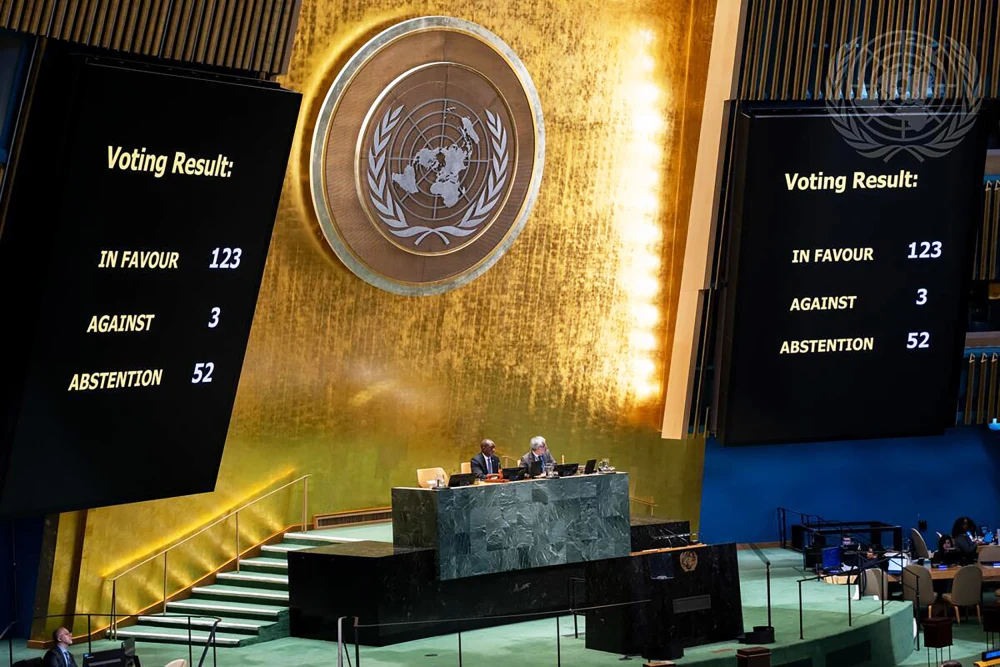
Talibdin “TD’ El-Amin, Ramblings Of An Issuecrat/ArgusTwenty million Africans were kidnapped and shipped to America during the transatlantic slave trade. Millions more died from disease while waiting in captivity at slave forts along the African coast. Those that made it to America were forced to work as slaves for generations.So the fact that 123 countries voted to acknowledge slavery as a crime against humanity at the United Nations General Assembly is historic.Led by Ghana, dozens of countries across Africa and the Caribbean presented the resolution last week during the Assembly’s session. It was overwhelmingly approved Thursday in a formal vote.You would think every country in the world would vote yes. Not so!Israel, United States, and Argentina were the only countries to vote against the resolution. Fifty-two countries abstained from voting, including several European countries who benefitted from the slave trade.Why would countries that have benefited from it oppose this resolution? I get the political and economic considerations present that to acknowledge it is to engage other policy steps of remuneration and reparations. That’s the wrong question.The right question is why would countries that fully acknowledge and commemorate the Jewish Holocaust every year (World Holocaust Remembrance Day is January 27th) cave when it comes to slavery? Where are the voices the decry never again, while we watch present day genocides continue to unfold of global Black and Brown peoples, such as in Rwanda, Sudan, Congo, the Rohingya in Myanmar, Uyghur in China and Palestine.Both enslaved Africans and Jews were victims of the world’s largest holocausts in history. You don’t get to pick and choose which genocide your country recognizes.For decades, Holocaust education and remembrance has been embedded in the world’s collective conscious.
The Holocaust is illegal to deny in several countries. There are museums. There are scholarships. There are monuments. There is a special remembrance day.Not to mention entire bodies of work within government and international institutions dedicated to “Never Again” letting something like that happen.Slavery — the African Holocaust — is still being debated.Is slavery being debated as a crime against humanity? No. It just passed. But how countries, specifically countries who benefited from slavery, deal with the aftermath is being debated.How is it okay for countries to say enslaved Africans don’t deserve the same recognition that Jewish victims of the Holocaust do?The U.S. Government’s Response (According to BBC Africa)The spokesperson for the US Mission to the United Nations said:“There is no legal basis for reparations under international law,” adding that such efforts would be an attempt to “redistribute today’s wealth”.Except slavery didn’t just happen. It continues to impact Black people around the world today.If you don’t believe me, just look at the wealth gap. Look at the educational gaps. Look at the incarceration rates. Look how long it took for this resolution to pass. Just look!And while we’re highlighting embedded government initiatives to right the worlds wrongs. Let that be a question for countries who voted against or abstained from the resolution. Why weren’t there people assigned to fight for the recognition of slavery as a crime against humanity?The comments from the Ghanaian officials explain the goal of the resolution better than I ever could:“This resolution is not about creating guilt. What we want is a dialogue on reparations in its broadest sense—how to repair the damage done.”HOW to repair is the key.Countries like the United States, many European countries and Israel can’t just throw money at the African diaspora and call it a day. Yes, financial reparations are great, but at the very least the funding should be funneled towards educational and institutional reform for African people around the world.And that conversation has to start with recognition, discussion, and support.There is no guilt to be had by Africans. We know our history. We know how we were affected by it. We know how we’re still affected by it today. We know what we want.What we don’t know is why the world continues to forget and have only a selective moral outrage in global humanitarian affairs.